
What are the Different Types of Mobile Apps: How to Choose the Right One

 Last Updated: March, 6 2026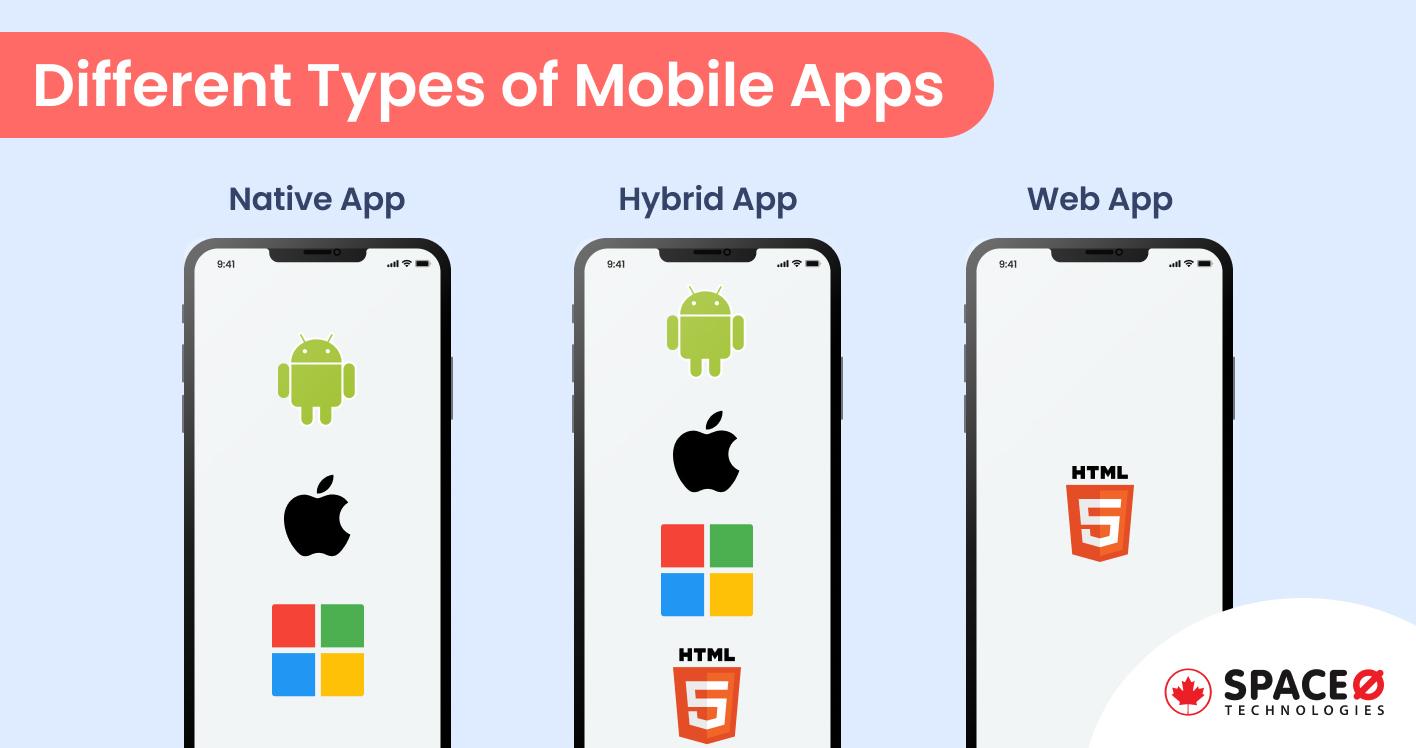
There are over 4 million mobile apps available across Google Play and the Apple App Store combined. According to a report by Statista, these numbers continue to grow each year as businesses invest in mobile app development to stay competitive.
Be it Android, iOS, or any other platform, you will find a mobile application for almost anything you can think of.
Mobile applications are an essential part of our daily routine. From browsing social media and streaming content to managing finances and ordering food, we rely on apps throughout the day.
If your business has still not launched a mobile app, there’s no better time than now. Having a mobile app for business plays an important role in this competitive world.
Mobile apps give you the chance to bring your business to the fingertips of your target customers.That’s exactly why we are here today. This guide takes you through the different types of apps so that you can choose the right one for your business.
Table of Contents
What are the Different Types of Mobile Apps?
There are three different types of mobile apps based on the technology used to build them. Now it depends on your business goals and objectives that which you must choose. This is a highly crucial decision and is one of the defining factors of your mobile strategy.
Let’s start getting familiar with the 3 types of mobile applications –
- Native Apps: Native mobile applications, as the name says, are native to one platform – Google’s Android, Apple iOS, or Windows phone. These (business) apps are developed specifically for one platform and ace at optimizing the user experience. They are known for operating swiftly and intuitively on the given platforms.
- Web Apps: Web applications are apps that run via a web browser on a mobile device using the internet. You do not need to download these apps to use them.
- Hybrid Apps: Hybrid apps are a fine mix of both native and web apps. Hybrid mobile apps are present in a shell of native apps, have their icon, and can be downloaded from an app store (like Google play). They use a web view control and present the HTML and JavaScript files using the native browser rendering engine.
3 Types of Mobile Apps by Technology
Now that we have mentioned the different types of apps, let us understand them step-by-step. We’ll also see the technologies involved in these mobile app types and the pros and cons for each.
Native Apps
Native apps are the type of mobile applications designed for a particular mobile device or OS (operating system) – Google’s Android, Apple iOS, or Windows phone. These types of apps can only work or function on the devices for which they are built. The widely known platforms are Android, iOS, and Windows.
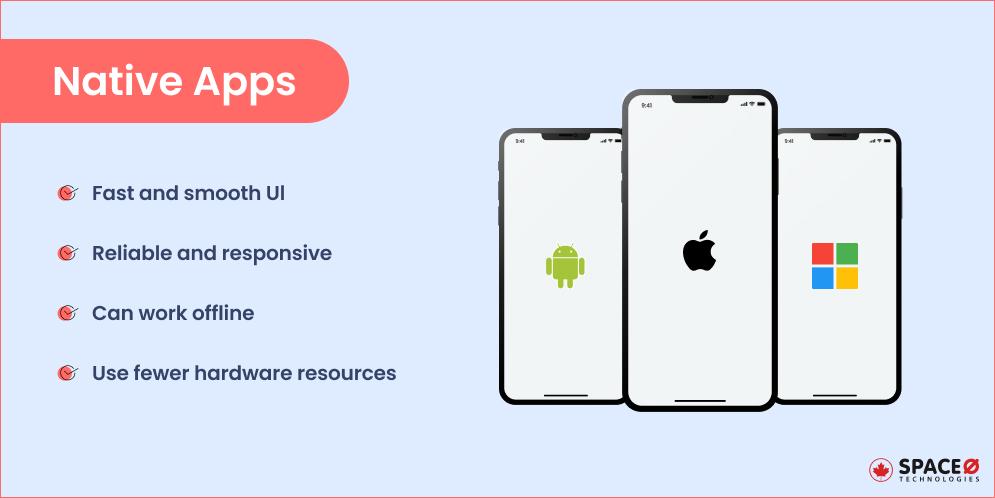
So an app that is designed for Windows Phones is not meant to work on iOS.
Native mobile apps are built for specific devices or operating systems and are well optimized for a particular platform, because of which such types of mobile apps deliver excellent performance.
Native Apps Development Technology
The technology used for native mobile app development> is specific to the platform that they are built for. For instance, programming languages to build iOS apps are Objective C or Swift, and Android apps are coded in Java programming language.
Also, native apps can only be distributed via app stores of respective platforms.
Pros And Cons Of Native App
Pros Cons - Native apps extend a fast and smooth UI. They are extremely reliable and responsive.
- Use fewer hardware resources as the coding is efficient.
- Have access to native device functionalities, making the whole experience great.
- Can work offline.
- Have the option of leveraging push notifications to increase app usage and propel the desired action. If you’re exploring this route, understanding the native vs hybrid app differences will help you make a confident decision.
- Limited to one platform and thereby one audience.
- Building the same app for two different platforms is time-consuming and costly.
- Maintaining and updating the app on different app stores is time-consuming and demanding.
- No code portability.
Web Apps
Web-based apps are internet browser-enabled mobile applications. You can access web applications via the web browsers on your mobile.
They do not need to be installed or downloaded on your mobile. Downloading them essentially means saving them as a bookmark.
The good part about web-based (business) apps is that they do not take much of your hardware resources, such as RAM and storage. They also do not have access to the device’s functionality as they run via a mobile browser or web browser.
If you’re planning to build a web-based application for your business, we’ve curated a detailed process guide on how to create a web application from scratch.
One of the best examples of web-based applications is remove.bg. The website removes the background from the images so that you can use them with different backgrounds.
Web Application Development Technology
Web apps are built using web technologies such as HTML, CSS, Ruby, and JavaScript so on. They are distributed via the web only and offer multi-platform support.
If you want to explore more details for web technologies, we have explained the popular web development frameworks with their features.
Pros And Cons Of Web Apps
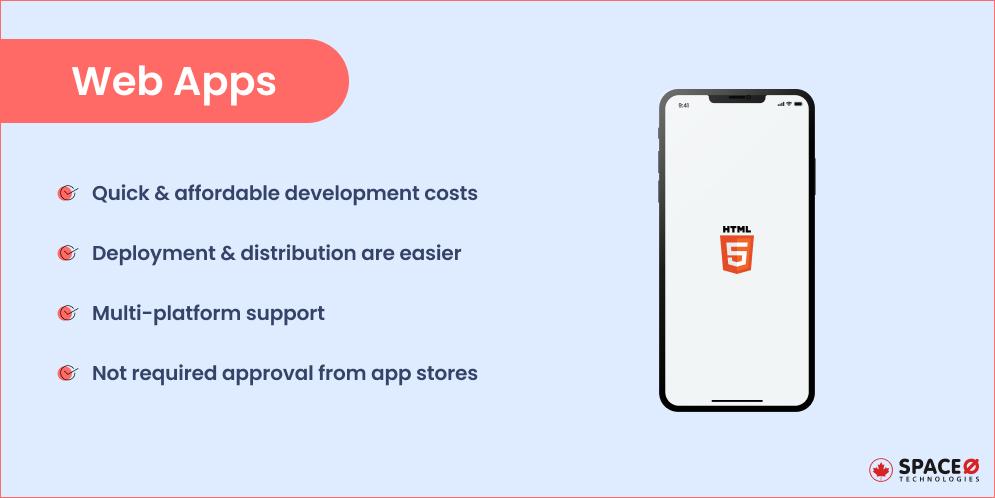
Pros Cons - Quick and affordable development costs as customizing to a specific platform is not needed.
- Deployment and distribution of web apps are easier. Updates are visible instantly and do not require an update in the respective app stores.
- Multi-platform support and do not need a separate code base for every platform.
- Needs no approval from app stores to slow/prevent launches.
- Not accessible via an app store. And cannot access the capabilities of a device.
- Slower speed.
- Less interactive UI.
- You can’t work without the internet.
- Do not run well on older devices and web browsers.
- The discoverability of the app depends on the reach of the website.
Hybrid Apps
As the name suggests, hybrid mobile apps are a mix of both native apps and web apps. Hybrid apps are sometimes referred to as cross-platform mobile apps. The only similarity between a hybrid mobile app and a cross-platform app is “code shareability”. Here we are focusing on the hybrid mobile application as they are much better.
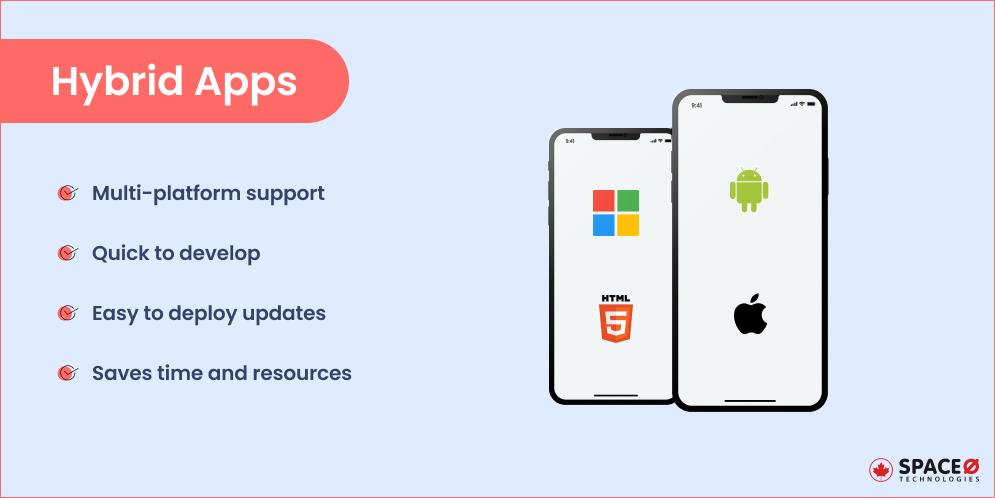
On the one hand, they are similar to native apps as you can easily download them from the app stores, and they appear on your home screen.
On the other hand, they use a browser embedded inside the app itself to render the data.
Even you will be surprised to know that some famous apps are hybrid mobile apps such as Instagram, Twitter and one of the examples of productivity apps is Evernote.
Hybrid Apps Development Technology
The hybrid applications use a whole set of different web development technologies and native APIs. They are coded in Objective C, Swift, HTML5, React-Native.
Their distribution is done through app stores and also has access to native APIs.
Pros And Cons Of Hybrid Applications
Pros Cons - Can access the native features of the device.
- Quick to develop. Because they use the technologies of the standard web.
- They are built on a single code base which saves time and resources.
- Multi-platform support.
- Easy to deploy updates.
- Can be made to work without an Internet connection if database support isn’t needed.
- Distributed through app stores.
- Performance is a little compromised compared to that of native apps.
- Some features might be missing on certain devices.
- High costs due to more customizations.
- Difficult to achieve an experience similar to native apps. As hybrid applications are developed for two platforms and are required to adjust to both simultaneously.
- Do not run well on older devices and browsers.
- You’ll perhaps face design issues that don’t support both devices.
Can’t decide which type of mobile app is best for you?
Connect with us today our app developers will guide you further.

How to Choose One from Different Types of Mobile Apps
Those were the three types of apps. Each of them, as you can see, comes with its own set of pros and cons.
So if you decide to get a mobile application developed and deployed, what would be the best type of app for your business?
Now to understand this, there are various factors that you need to keep in mind.
These factors include but are not limited to-
- App development cost
- App development timeline
- Deployment of the app
- The type of mobile app
- Features that you want to integrate
- App specifications
- Target audience
These factors must be well-researched before the development of any type of mobile app.
With that said, let us help you understand when to choose a certain type of mobile application development.
When to Choose Native App Development?
Build a native application if you want/have –
- High performance and well-rounded usability
- High user experience and user interface
- Highly secure applications
- Single codebase
- An application that can access all the resources and capabilities of the smartphone. For iPhone app development, native is the preferred approach.
- Optimum/sufficiently high budget for app development
- A fast, stable, and responsive application
- To take full advantage of the hardware present in the mobile devices
- Third-party integrations support
- An app that is scalable and can be updated quickly in the future for new features
- Long-term investment protection
When to Choose Hybrid App Development?
Build a hybrid app if you want/have –
- Sufficiently high performance and standard usability
- Secure applications
- Good-to-moderate budget for development
- Patient and can wait for a decent amount of time
- To access the hardware and take advantage of it on a mobile device
- A single codebase
- A vast userbase across platforms. Frameworks like Flutter and React Native make hybrid development efficient.
- Support for third-party integration
- Fine UI for the app
When to Choose Web App Development?
Build a web app if you want/have –
- To deploy an app quickly
- A single codebase
- Your app requires network access
- A tight budget
- To be accessible on all platforms
- You do not want to wait for approval from applications stores
- Support for third-party integration
Having said that, there’s no one-size-fits-all. There is not a single best type of mobile app. The type of mobile app that addresses your business needs the best is essentially the best for you.
Start with analyzing your business needs and then go on to decide which type of mobile app fits the best and get a range of benefits of having a mobile app for your business.
Want to hire an app development company that comprehends your needs and delivers the best solution? Just talk to our experts.
Frequently Asked Questions
What are the categories of apps?
There are four main categories of mobile apps, including gaming apps, education apps, business apps, eCommerce apps, and more. According to statista.com, gaming apps were the most popular app category in the Google Play Store, accounting for 13.56% of available apps whereas education apps were ranked second with a 9.45% share.
What kind of apps are popular?
Currently, the most popular mobile apps are Uber, Instagram, TikTok, Airbnb, Netflix, Amazon, YouTube, and Spotify. If you are planning to develop an app, exploring popular categories of apps can help you identify the right market opportunity.
Which type of app should I select if I want to launch an app quickly?
If you want to launch an app quickly, the best option is web apps as customizing to a specific platform is not needed. You can also consider building a progressive web app for faster time-to-market.
Which type of apps support third-party integration?
The types of apps that support third-party integration are Native applications and Hybrid apps. Any category of application that falls under this category supports third-party integration.
Which type of app development needs low investment?
The Web app is one such type of application that requires a low amount of investments because of less customization. If you want to develop an app by investing a low amount, then web application is the best option. Apart from this, you can launch an MVP version of your app initially to validate the idea before investing in full-scale development.
Build the Right Type of Mobile App with Space-O Technologies
Choosing between native, web, and hybrid mobile apps comes down to your business goals, budget, and target audience. Each type of mobile app has its strengths, and the right choice depends on what you need the app to accomplish.
Native apps deliver the best performance and user experience. Web apps offer quick deployment at a lower cost. Hybrid apps strike a balance between the two with a shared codebase across platforms.
No matter which type of mobile application you choose, the key is working with a team that understands your requirements and delivers a quality product on time.
Space-O Technologies is a trusted mobile app development company based in Toronto, Canada with 7+ years of experience building mobile applications for Fortune 500 companies and growing businesses alike. With 100+ happy clients worldwide and a 65% repeated and referral business rate, we have the expertise to guide you from idea to launch.
Whether you need a high-performance iOS app, a scalable Android app, or a cross-platform solution built with React Native or Flutter, our team can help you make the right call.
Have a mobile app idea in mind? Get in touch with Space-O today for a free consultation and project estimate.


What to read next


 All our projects are secured by NDA
100% Secure. Zero Spam
*All your data will remain strictly confidential.
Trusted by


Bashar Anabtawi 
Canada
“I was mostly happy with the high level of experience and professionalism of the various teams that worked on my project. Not only they clearly understood my exact technical requirements but even suggested better ways in doing them. The Communication tools that were used were excellent and easy. And finally and most importantly, the interaction, follow up and support from the top management was great. Space-O not delivered a high quality product but exceeded my expectations! I would definitely hire them again for future jobs!”

Canada Office
2 County Court Blvd., Suite 400,
Brampton, Ontario L6W 3W8
Phone: +1 (602) 737-0187
Email: sales@spaceo.ca